How to write a short video script for TikTok, Reels or Shorts (15–60 seconds)
Published October 1, 2026 · 6 min read
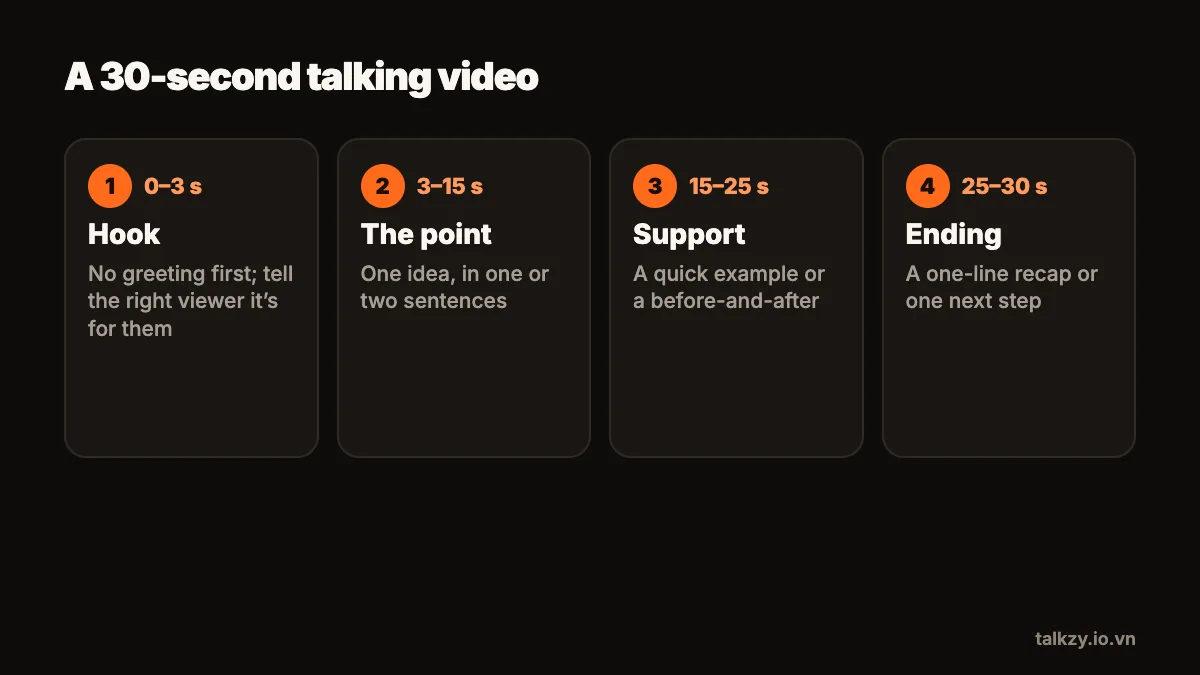
A good short video script has four parts: a hook that says what the viewer gets in the first two or three seconds, one single point, one piece of proof or an example, and a clear ending. At a conversational pace, a 30-second video is only about 70 words, so every line has to earn its place.
This guide walks through each part with examples, then covers how to write it so it is easy to say, how to check the length and how to record it in short takes. It works for TikTok, Instagram Reels, YouTube Shorts and Facebook Reels alike.
Why do short videos need a script at all?
Short videos look improvised, but the ones that hold attention rarely are. Without a script, people start slowly, explain the background first and get to the point at second twenty, when many viewers have already scrolled on. A script lets you put the most interesting sentence first and cut everything that doesn’t help.
A script doesn’t have to make you sound scripted. Written the way you talk, and read in short phrases while looking at the lens, it sounds like you on a good day.
What makes a good hook?
The hook is the first sentence, and its only job is to tell the right viewer “this is for you”. A few patterns that work for talking videos:
- The promise: “Here’s how to film yourself at home without looking at your notes.”
- The mistake: “If your videos sound flat, it’s probably your script, not your voice.”
- The question: “Why do you look down every time you read on camera?”
- The result first: “This one change made my takes twice as fast to record.” Only use this if it is true for you.
Say the hook in the first two or three seconds, without a greeting before it. Put a matching line of on-screen text if the platform’s viewers often watch with the sound off.
What goes in the middle?
One point. A short video that tries to cover three ideas usually lands none of them. After the hook, give the point in one or two sentences, then one piece of support: a quick example, a before-and-after, a demonstration or a personal experience.
If you find you have three good tips, that is three videos, or one longer video with sections. Short-form rewards focus.
How should a short video end?
End on the most useful line, not on a fade-out. Two common endings:
- A one-sentence recap of the point, so it sticks.
- One clear next step: try it, save the video for later, or watch the next part. Ask for one thing, not three.
Stop talking as soon as you’ve said it. A second or two of silence before you cut is enough.
How long should the script be?
Work from your speaking speed. At about 140 words per minute, 15 seconds is roughly 35 words, 30 seconds about 70, and 60 seconds about 140. Measure your own pace once and you’ll know your budget for each length.
A useful template for a 30-second video: hook (10–15 words), point (20–25 words), example (20–25 words), ending (10 words). Write it, read it aloud with a timer, and cut until it fits with a little breathing room.
How do I write it so it’s easy to say?
- Short sentences, one idea each. You should be able to say each one in a single breath.
- Everyday words, contractions and the phrasing you’d use with a friend.
- A new line for each thought, so the gap reminds you to pause.
- Numbers written the way you say them, and tricky names spelled the way they sound.
Read the draft aloud twice. Anything you stumble on, rewrite; anything that sounds like an essay, simplify.
How do I film it from the script?
- 1Put the phone at eye level, with light in front of you.
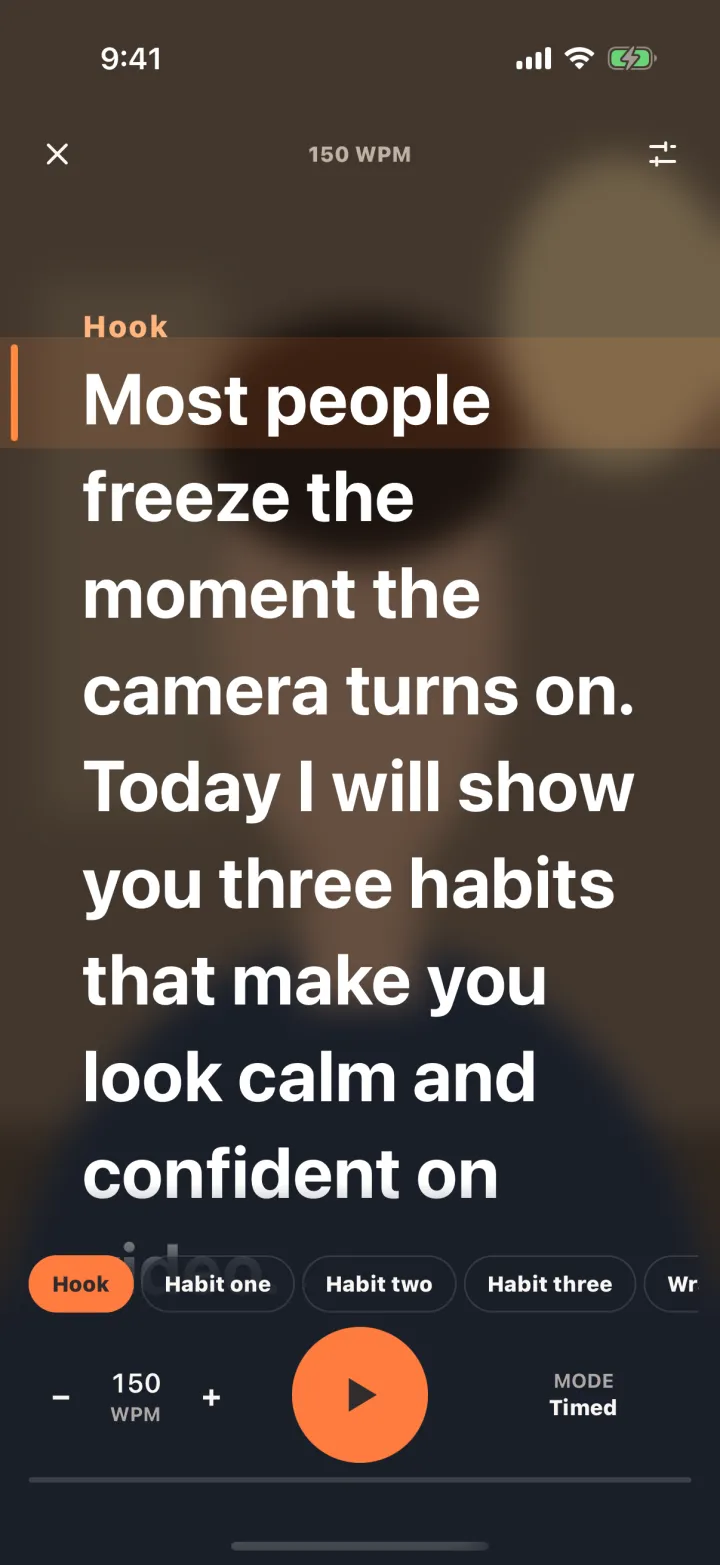
- 2Keep the script as close to the front camera as you can — a narrow column right under the lens is best — so your eyes stay near it.
- 3Record the hook on its own, several times, until it’s confident. It matters most.
- 4Record the rest in one or two short takes and keep the best of each.
- 5Watch it back once with the sound off: if your eyes are scanning, narrow the text or move the phone back.
Where Talkzy helps
In Talkzy you paste the script, see its word count and read time at your speed, and record with the text in a narrow column right under the front camera. A line starting with # begins a section, so the hook can be its own section that you jump back to and retake.
Voice-follow lets you take your time: the text scrolls as you talk and waits when you pause, using speech recognition on the device. Each take is saved as its own clip named after the script, so picking the best hook is easy. There is no watermark on your takes.